
 Multiple Faces Detected


 September 21st, 2026
The answer to “which country scams the most” depends entirely on what you are measuring. If you are asking where the largest organized scam operations originate, the romance scam networks, the pig butchering compounds, the fraud factories the list looks one way. If you are asking which countries leave their populations most vulnerable to being scammed, the list looks completely different. Most rankings online conflate the two or only address one. This article keeps them separate, because confusing them is how misleading content gets made.
Name Search Examples
To get more accurate results, enter the full name including at least First name, Middle name and Last name.
Email Search Examples
Phone Search Examples
Username Search Examples
Address Search Examples
Start typing the initial part of the address and select from the addresses given dropdown afterward.
We Respect Your Privacy.
Two Different Questions, Two Different Lists
Question 1: Where do scams originate?
This measures the countries where organized fraud operations are documented as running, where scammers are based, where compounds operate, and where law enforcement has made the most arrests for fraud-related crimes. The FBI, Interpol, and the United Nations are the primary sources for this data.
Question 2: Which populations are most vulnerable to being scammed?
This measures the countries whose residents are least protected, with the weakest consumer protections, lowest digital literacy infrastructure, and poorest fraud detection systems. Sumsub’s Global Fraud Risk Index is the primary source for this metric.
A country can rank high on one list and not appear on the other. Nigeria ranks high as a scam origin country and also ranks in the top 15 most vulnerable populations, a double entry that reflects both the scale of outbound scam operations and the limited domestic fraud protection infrastructure. Pakistan ranks as the least fraud-protected country in the world by the vulnerability index and does not rank as a major scam origin hub. These are different problems.
The Top 10 Romance and Pig Butchering Scam Hotspots
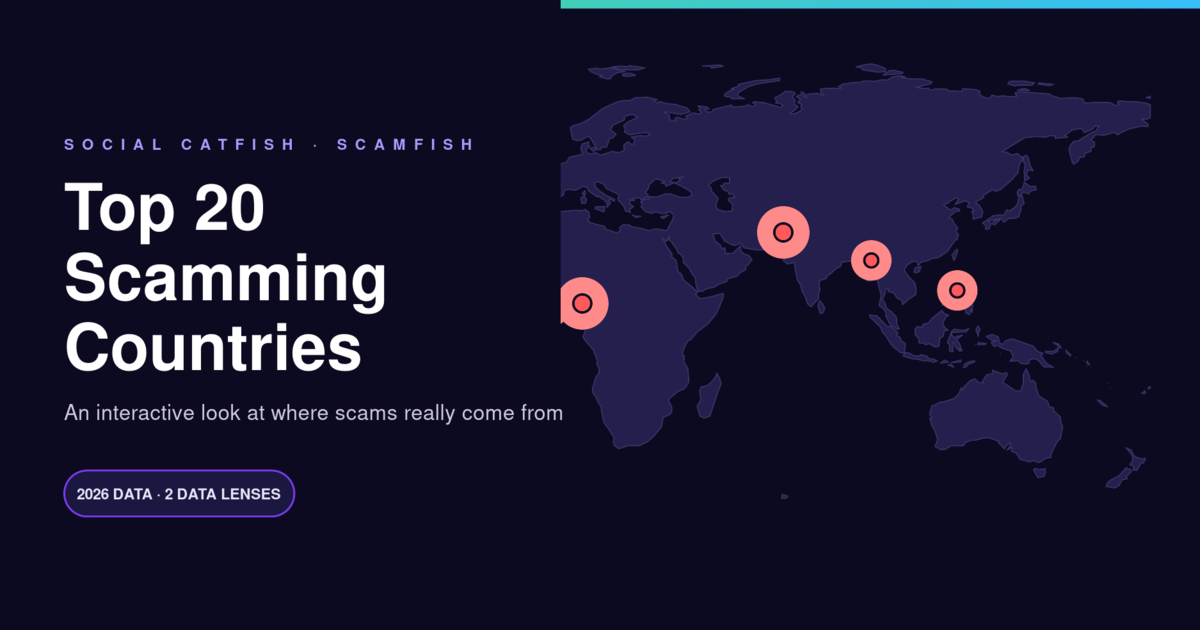
Where in the world do today’s scams actually come from?
Two lenses on the same question — tap a pin or a country to see why it’s on the map.
A country of origin is a pattern, not proof. The only way to know who’s really behind a specific profile is to check it directly — a reverse image and username search works no matter where the account claims to be from.
Search Before You Trust the ProfilePrivate and confidential — only you see the results.
These countries are documented as primary origin points for organized online fraud, particularly romance scams and the investment fraud variant known as pig butchering. Sources include FBI Internet Crime Complaint Center reporting, Interpol operational data, UN reports on scam compounds, and the US Institute of Peace.
1. Nigeria
Nigeria has been the most consistently documented source of organized romance scam operations for decades. The loosely organized networks known as Yahoo Boys, named for the early email platform their operations originated on, have evolved significantly, now running sophisticated long-form romance and investment scams across multiple platforms. The FBI reported over $1.3 billion in romance scam losses in 2024, with Nigerian-origin operations accounting for a significant share. Enforcement has been increasing: the EFCC (Nigeria’s Economic and Financial Crimes Commission) has made thousands of fraud-related arrests in recent years, but the scale of operations continues to outpace enforcement.
2. Ghana
Ghana has emerged as a fast-growing hub as some Nigerian operators have relocated operations to take advantage of lighter enforcement and lower operational costs. Interpol’s 2025 pan-African anti-fraud operation resulted in 68 arrests in Ghana alone, out of 260 total across 14 countries. Operations documented in Ghana include romance scams, advance-fee fraud, and business email compromise schemes targeting victims in the US, UK, and Europe.
3. Myanmar
Myanmar is the center of the most disturbing development in global scam operations over the past four years: the pig butchering scam compound. Large-scale fraud facilities in Myanmar, particularly in the border regions controlled by non-state armed groups, have been documented by the UN as operating with trafficked laborers lured with false job offers who are then forced to run scams under threat of violence. The operations target victims globally with long-form investment scams that can take months to execute. The UN estimates tens of thousands of people are being held in these conditions across Southeast Asia.
4. Cambodia
Cambodia hosts some of the largest documented scam compound operations outside Myanmar. Sihanoukville and several other locations have been identified by investigative journalists and the UN as centers of pig butchering operations, many operating openly in special economic zones with limited regulatory oversight. The Cambodian government has made some enforcement moves under international pressure, but operations have largely relocated or restructured rather than closed.
5. Laos
Laos rounds out the Southeast Asian compound cluster, with documented operations concentrated in the Golden Triangle Special Economic Zone. Similar to the Myanmar and Cambodia operations, these facilities have been linked to trafficking and forced labor, and primarily run investment fraud targeting victims in China, Taiwan, Southeast Asia, and increasingly the United States and Europe.
6. Ivory Coast
Ivory Coast is a significant hub for West African internet fraud, particularly romance scams and advance-fee schemes. Known locally as brouteurs, scam operators in Ivory Coast have been documented by investigative journalists and Interpol. Operations tend to be smaller and more decentralized than the Nigerian networks but run at significant volume.
7. South Africa
South Africa hosts a sophisticated fraud ecosystem that includes business email compromise, investment fraud, and romance scams operating at both domestic and international scales. The country’s relatively advanced banking and telecommunications infrastructure makes it both a target and an origin point. Interpol’s 2025 operation included significant South African arrests.
8. Philippines
The Philippines has been identified as a base of operations for several large-scale pig butchering and romance scam networks, with some operations reportedly run by Chinese criminal organizations. The country’s English-language proficiency makes it operationally useful for targeting English-speaking victims, and several high-profile anti-fraud operations have resulted in arrests of both operators and trafficked workers.
9. India
India’s position on this list reflects primarily the large volume of tech support and impersonation scam operations documented as originating there, particularly the IRS, Social Security Administration, and Microsoft impersonation schemes that target elderly Americans. These are typically small call center operations rather than large compounds, but they operate at massive scale collectively. Indian authorities have made thousands of arrests in this category.
10. Pakistan
Pakistan appears on both lists as a scam origin country for online fraud operations and as the least fraud-protected population in the world, according to the Global Fraud Risk Index. Documented operations include romance scams, advance-fee fraud, and cryptocurrency investment fraud targeting victims in Western countries.
The 15 Countries Least Protected Against Fraud (Global Fraud Risk Index 2026)
Sumsub’s Global Fraud Risk Index measures population vulnerability to fraud rather than fraud origin. It assesses consumer protection infrastructure, digital literacy, financial regulation, and fraud detection capabilities. A high ranking here means residents of that country are statistically most likely to be targeted successfully, not that the country is a source of fraud operations.
Most vulnerable (least protected):
- Pakistan
- Indonesia
- Nigeria
- India
- Tanzania
- Uganda
- Bangladesh
- Rwanda
- Azerbaijan
- Sri Lanka
- Ethiopia
- Brazil
- Armenia
- Kenya
- Colombia
Most protected (for context):
Luxembourg, Denmark, Finland, Norway, the Netherlands, Switzerland, New Zealand, Sweden, Austria, Singapore, Slovenia, Israel, Malta, Lithuania, and Australia rank as the most fraud-protected populations globally.
The protection gap between the least and most protected countries reflects differences in regulatory infrastructure, financial system maturity, consumer education, and enforcement capacity rather than moral differences between populations. Residents of high-vulnerability countries are more likely to be scammed both by domestic fraud operations and by international scammers who specifically target less protected markets.
A Country of Origin Does Not Tell You Who You Are Talking To
The practical limitation of all scam country data for individual protection is that a scammer’s country of origin tells you very little about how to identify them before being defrauded. Scam operations routinely use VPNs, international phone numbers, and fabricated identities that place them in completely different locations than where they actually operate. A romance scammer running operations from a compound in Myanmar may present as an American military officer, a Canadian doctor, or a British engineer depending on what profile their target is most likely to trust.
What identifies a scammer is not their country of origin but inconsistencies in their claimed identity, profile photos that belong to someone else, phone numbers that trace to VoIP services with no verified registration, usernames that appear across multiple platforms under different names, and stories that do not hold up against basic verification.
Social Catfish’s reverse image search, reverse phone lookup, and cross-platform username search address each of these verification points regardless of where the person behind the screen is actually located. A profile photo can be checked for its real origin through facial recognition. A phone number can be confirmed as a real carrier line or flagged as a VoIP burner number. A username can be cross-referenced against every platform where it is active to confirm whether the identity is consistent.
All searches are completely confidential. The person being searched receives no notification.
Whether they say they’re from Lagos, verify anyway
Scam-origin data shows patterns, not proof. It can’t tell you who’s really behind one specific profile. A reverse image and username search works exactly the same way no matter what country, city, or story they give you.
Run a Search NowPrivate and confidential — only you see the results.
FAQ
Because they are measuring different things. Sources that rank by fraud complaint volume show where victims are located. Sources that rank by origin track where documented operations run from.
No. The Global Fraud Risk Index measures how vulnerable a country’s population is to being defrauded essentially, how protected residents are by their country’s financial systems, regulatory infrastructure, and digital literacy programs.
The most current sources as of 2026 are Sumsub’s Global Fraud Risk Index 2025, Interpol’s 2025 pan-African operation results, the FBI’s Internet Crime Complaint Center 2024 annual report, and the UN’s ongoing documentation of Southeast Asian scam compound operations. The Global Organized Crime Index 2025 provides a broader organized crime lens.
In many cases, yes: organized fraud operations documented in Nigeria, Myanmar, Cambodia, and the Philippines are run from those locations by people who live or work there. However, scam operations frequently use VPNs, international phone numbers, and fabricated identities to misrepresent their location to targets.
The most reliable checks are: reverse image search their profile photo to confirm it belongs to the person they claim. Social Catfish’s reverse image, phone, and username searches cover all three checks simultaneously and confidentially.
Conclusion
There is no single answer to which country scams the most because the question contains two different measurements. Where organized fraud operations originate is one question. Where populations are most vulnerable to being defrauded is another. The 10 countries identified as primary scam origin points reflect documented law enforcement data. The 15 most vulnerable countries reflect infrastructure and regulatory gaps. Understanding both is more useful than a single ranking that conflates them.
For individual protection, what matters more than any country ranking is knowing how to verify who you are actually talking to, because the most sophisticated scam operations are specifically designed to avoid looking like they come from anywhere you would recognize as a risk.
Name Search Examples
To get more accurate results, enter the full name including at least First name, Middle name and Last name.
Email Search Examples
Phone Search Examples
Username Search Examples
Address Search Examples
Start typing the initial part of the address and select from the addresses given dropdown afterward.
We Respect Your Privacy.