
 Multiple Faces Detected


 September 21st, 2026
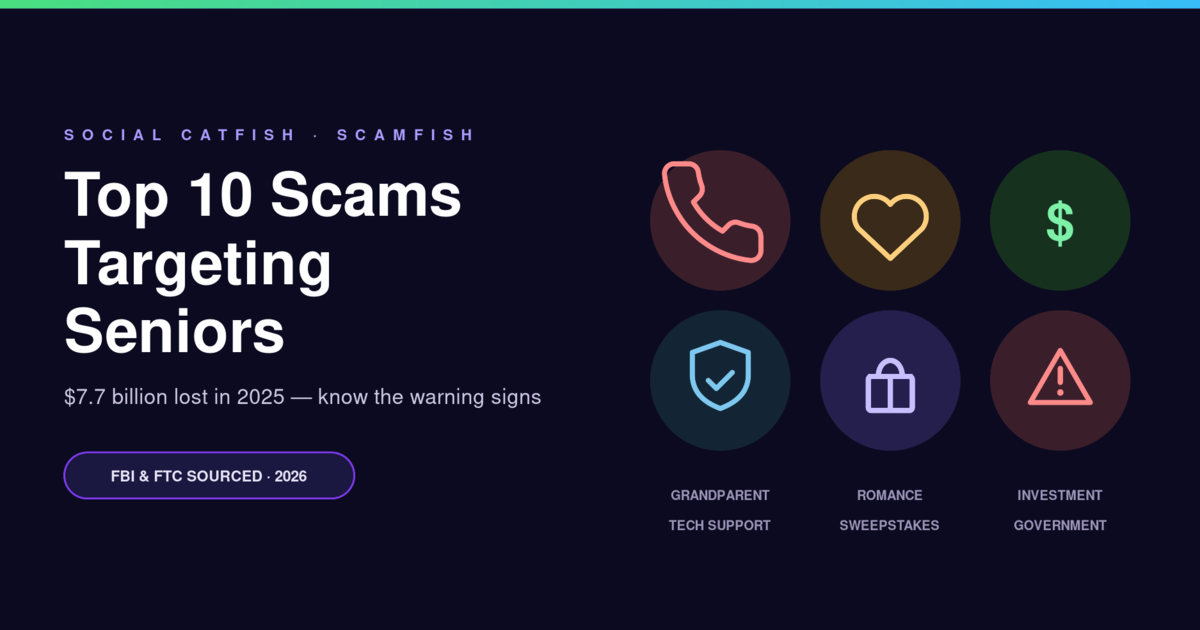
Adults 60 and older filed more than 201,000 fraud complaints with the FBI in 2025, reporting losses exceeding $7.7 billion, a 37 percent increase year over year. The FTC reports that the number of older adults reporting losses of $10,000 or more has quadrupled since 2020, and reports of losses exceeding $100,000 have increased nearly sevenfold in the same period. These are not isolated incidents. They represent a sustained, organized targeting of one of the most financially vulnerable demographic groups in the country.
This guide ranks the ten scams responsible for the majority of that damage, explains the specific red flag for each, and tells you what to actually do, not just what to watch for.
Name Search Examples
To get more accurate results, enter the full name including at least First name, Middle name and Last name.
Email Search Examples
Phone Search Examples
Username Search Examples
Address Search Examples
Start typing the initial part of the address and select from the addresses given dropdown afterward.
We Respect Your Privacy.
The Top 10 Scams Targeting Seniors

1. Government Impersonation Scams
What it is:
Callers or emailers claim to represent the IRS, Social Security Administration, Medicare, or another government agency. The typical claim is that you owe back taxes, your Social Security number has been compromised, or your Medicare coverage is about to be suspended. The caller demands immediate payment or personal information to resolve the issue.
The biggest red flag:
Real government agencies contact you by mail first and never demand immediate payment by gift card, wire transfer, or cryptocurrency. Any contact claiming to be the IRS or SSA that demands immediate phone payment is a scam without exception.
What to do:
Hang up. Do not call back the number provided. Contact the agency directly using the number on its official .gov website to confirm whether any legitimate issue exists.
2. Tech Support Scams
What it is:
A pop-up, email, or phone call warns that your computer has a virus or has been hacked. The caller claims to be from Microsoft, Apple, or another technology company and asks for remote access to your device to fix the problem. Once they have access, they either steal data, install malware, or demand payment for fake repairs.
The biggest red flag:
Microsoft, Apple, and legitimate technology companies do not proactively call customers about computer problems. Any unsolicited contact claiming your device has a virus is a scam.
What to do:
Do not give remote access to any unsolicited caller. Close the pop-up by restarting the computer if needed. For more details on how these scams operate, see our full Tech Support Scam guide.
3. Grandparent and Person-in-Need Scams
What it is:
A caller claims to be a grandchild, family member, or friend in an emergency — arrested, in a car accident, hospitalized abroad — and needs money immediately. They ask you not to tell other family members and often have a second caller posing as a lawyer or police officer to add credibility.
The biggest red flag:
The request for secrecy. Real emergencies do not require keeping other family members in the dark, and real lawyers and police officers do not call to request cash or gift card payments.
What to do:
Hang up and call the family member directly at a number you already have, not the number provided by the caller. Confirm with another family member before taking any other action. For the full breakdown of how this scam works, see our Grandparent Scam guide.
4. Investment and Cryptocurrency Scams (Including Pig Butchering)
What it is:
The NCOA identified investment scams as the costliest senior scam category in 2025, with losses exceeding $3.5 billion. Cryptocurrency-specific fraud hit more than 42,000 older adult victims for $4.3 billion in the same period. The most sophisticated version is pig butchering, a long-form investment scam where the scammer builds trust over weeks or months before introducing a fake investment platform that shows fabricated gains until the victim has transferred everything they have.
The biggest red flag:
Any investment opportunity introduced by someone you met online on a dating app, social media, or messaging platform that promises consistent high returns and shows you gains on a platform you did not independently find. The platform itself is controlled by the scammer and shows you whatever numbers they want you to see.
What to do:
Never invest through a platform introduced by someone you met online without first verifying the platform through independent sources and the investment professional through SEC or FINRA registration databases. If you want to verify who you are actually talking to, see the verification section below.
5. Romance Scams
What it is:
A scammer builds a romantic relationship over weeks or months through a dating app, social media, or messaging platform, then introduces a financial emergency or investment opportunity. The FBI reported romance scam losses exceeding $1.3 billion in 2024. The NCOA explicitly connects romance scams to pig butchering, noting that many long-form romance scams pivot to investment fraud once sufficient trust has been established.
The biggest red flag:
A relationship that has never resulted in an in-person meeting, where the person always has an excuse not to video call, and where a financial request arrives after a period of intense emotional connection.
What to do:
Run the person’s profile photo through a reverse image search before the relationship progresses further. Verify their identity before any financial discussion. See the verification section below for how to do this in minutes.
6. Financial Services and Phishing Scams
What it is:
Emails, texts, or calls that appear to come from your bank, credit union, or financial institution warn of suspicious account activity and ask you to verify your account by clicking a link or calling a number. The link leads to a spoofed login page that captures your credentials.
The biggest red flag:
Any message creating urgency about your financial account that contains a link or a phone number different from what appears on your card or statement. Legitimate banks do not ask you to verify your account through a link in an email.
What to do:
Do not click the link. Navigate directly to your bank’s official website by typing the address yourself, or call the number on the back of your card.
7. Sweepstakes and Lottery Scams
What it is:
A letter, email, or call informs you that you have won a prize, lottery, or sweepstakes you did not enter. To claim the winnings, you must pay a tax, processing fee, or customs charge first. The fees are collected but the prize never arrives.
The biggest red flag:
No legitimate prize or sweepstakes requires upfront payment to claim winnings. Tax on legitimate prizes is handled by the recipient through their own tax filing, not through a fee paid to the prize administrator.
What to do:
Do not send any payment. Report the contact to the FTC at reportfraud.ftc.gov and discard any follow-up communication.
8. Charity Scams
What it is:
Fake charities solicit donations after natural disasters, during holiday seasons, or in response to current events. They may use names similar to well-known legitimate charities and often contact potential donors by phone. Donations go directly to the scammer rather than to any charitable cause.
The biggest red flag:
Pressure to donate immediately by gift card, wire transfer, or cryptocurrency rather than through a secure online payment. Legitimate charities accept checks and standard card payments and do not create urgency around donation timing.
What to do:
Verify any charity at charitynavigator.org or give.org before donating. Search the charity name alongside the words “scam” or “complaints” in Google. Donate directly through the charity’s official website rather than through a link provided in a call or email.
9. Robocalls and the “Can You Hear Me?” Scam
What it is:
Robocall scams use automated systems to reach thousands of numbers simultaneously. The “can you hear me?” variant records your “yes” response and uses it as supposed voice authorization for fraudulent charges. Other robocall scams pitch fake warranties, debt relief, or insurance products.
The biggest red flag:
Any call that begins with a recorded message rather than a live person, or that asks you to press a number to continue, should be treated with skepticism. The “can you hear me?” prompt is specifically designed to capture a recorded yes.
What to do:
Hang up on any robocall that is not from a known organization you have an existing relationship with. Do not press any number to be removed from a list; this confirms your number is active and typically results in more calls. Report the number to the FTC at donotcall.gov.
Why Seniors Specifically
The NCOA identifies several specific factors that make older adults a disproportionate target for organized fraud, none of which reflect individual failure or gullibility.
Assumed savings and accessible assets:
Older adults collectively hold more accessible savings and home equity than other demographic groups, making them higher-value targets for operations that invest significant time in establishing trust before making a financial ask.
Targeted outreach:
Scammers specifically acquire lists of older adults from data broker sites and other public sources, and the 41 percent of high-loss scam contacts that begin by phone reflects a deliberate targeting of demographics more likely to answer and engage with phone-based contact.
What to Do If You Are Not Sure Who You Are Talking To
For items 4 and 5, specifically investment scams and romance scams, the most common point of failure is trusting an identity that has not been verified. Both categories rely on the target believing the person they are talking to is who they claim to be: a successful investor, a military officer, a professional working abroad.
Reverse image search their profile photo:
Save any photo the person has shared as a profile photo, a photo sent during a conversation, or any image associated with their claimed identity, and upload it to Social Catfish’s reverse image search. The facial recognition finds where that face appears online and under what names. A genuine person’s photos appear consistently under their own identity. A stolen photo traces back to the real person it was taken from, often appearing under a completely different name on their actual social media.
Reverse phone search any number they have shared:
Enter their phone number into Social Catfish’s reverse phone search. The search returns the real name and carrier registration behind the number and flags whether it is a VoIP or burner line with no verified identity, one of the most consistent signals in both romance scam and investment scam operations.
Cross-reference their username or name:
Enter any username, name, or email address they have shared into Social Catfish’s cross-platform search. The search returns every platform where that identity is active alongside the real identity connected to it, confirming whether the person’s story is consistent across sources or manufactured for this specific interaction.
All searches are completely confidential. The person being researched receives no notification.
If you are concerned that a parent or family member is already in contact with a scammer, see our full guide: My Parent Won’t Believe Their Online Partner Is a Scammer.
Different scam, same missing step: nobody checked who was really on the other end.
Grandparent & imposter scams
A voice that sounds just like your grandchild says they’re in trouble and begs you not to tell anyone. AI voice cloning has made this harder to catch by ear alone.
Hang up and call your grandchild back directly, or verify the number and any name involved before sending anything.
Romance & investment scams
Someone you met online has become a real relationship, and now they need help — money for a flight, a medical bill, or “one investment opportunity.”
A reverse image and username search on their photo and profile shows if they’re really who they claim to be, before any money moves.
Every scam on this list works by creating urgency before you have time to check. Verifying who you’re actually talking to — a name, a photo, a phone number — takes a few minutes and breaks the pattern every time.
Verify Before You Send AnythingPrivate and confidential — only you see the results.
FAQ
By financial loss, investment and cryptocurrency scams are the costliest category, with the NCOA reporting $3.5 billion in investment scam losses and $4.3 billion in cryptocurrency-specific fraud losses from older adult victims in 2025.
The FBI’s 2025 Internet Crime Complaint Center report shows adults 60 and older reported losses exceeding $7.7 billion in 2025, a 37 percent increase from the prior year. The FTC reports that the number of older adults reporting individual losses of $10,000 or more has quadrupled since 2020, and losses of $100,000 or more have increased nearly sevenfold in the same period.
The most important first step is not confrontation; direct accusation often accelerates secrecy and pushes the victim closer to the scammer. Start by gathering verifiable information: run the contact’s profile photo through Social Catfish’s reverse image search and check their phone number through a reverse phone search.
The FTC reports that among older adults who reported losses of $10,000 or more, 33 percent involved cryptocurrency and 20 percent involved bank transfers. Gift cards remain common for lower-value scams due to their immediate, irreversible nature.
Report to the FTC at reportfraud.ftc.gov and to the FBI’s Internet Crime Complaint Center at ic3.gov. If the senior’s bank accounts or finances have been accessed, contact the bank immediately; recovery windows for wire transfers narrow rapidly. The FBI’s Elder Fraud Hotline at 1-833-FRAUD-11 is specifically staffed for elder fraud cases.
Conclusion
The ten scams above account for the majority of the $7.7 billion in annual losses reported by adults 60 and older. Each one operates on the same principles: manufactured trust, artificial urgency, and pressure that prevents verification. The protection that works across all ten categories is the same: slow down, consult someone else, and verify the identity of anyone asking for money or personal information before acting. When the person is someone you met online and the stakes are financial, Social Catfish’s verification tools close the gap between who someone claims to be and who they actually are.
Name Search Examples
To get more accurate results, enter the full name including at least First name, Middle name and Last name.
Email Search Examples
Phone Search Examples
Username Search Examples
Address Search Examples
Start typing the initial part of the address and select from the addresses given dropdown afterward.
We Respect Your Privacy.