
 Multiple Faces Detected


 March 10th, 2026
Online dating has never been more popular, and online dating scams have never been more dangerous. With over 350 million people using dating apps worldwide and the industry generating $6.18 billion in revenue in 2024, the platforms where people search for genuine human connections have become the hunting grounds of choice for organized criminal networks operating at an industrial scale.
According to the Federal Trade Commission, consumers reported losing more than $12.5 billion to fraud in 2024, which represents a 25% increase over the prior year.
What’s driving this surge is not simply more scammers; it’s smarter ones. Artificial intelligence, deepfake technology, and industrialized fraud operations have fundamentally transformed what online dating scams look like in 2026. Understanding what is happening and why matters for anyone who uses a dating app, social media platform, or messaging service to meet people online.
Using a tool like Social Catfish to verify who you’re talking to before things get personal is one of the most effective steps you can take.
The Scale of the Problem: By the Numbers
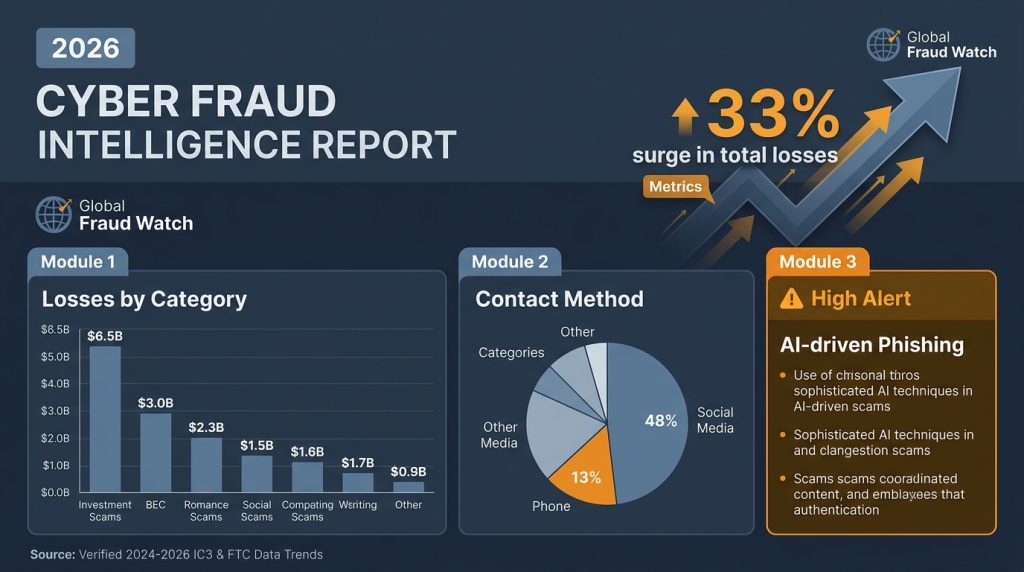
The numbers behind online dating fraud paint a picture that is difficult to ignore:
- The FTC recorded 55,604 romance scam complaints in the first nine months of 2025, a 22% increase over the same period in 2024
- Romance scam losses in 2024 reached $824 million, up from $547 million in 2021, a more than 50% increase in three years
- The median loss per romance scam victim is approximately $2,000, the highest median loss of any form of imposter scam tracked by the FTC
- 40% of current online daters report having been targeted by a dating scam, according to Norton’s 2026 Insights Report
- Dating platforms lead all industries in identity fraud rates at an 8.9% share, double the rate seen in banking and insurance
- A 63% uptick in romance scam attempts was reported between 2024 and 2025 by 340 financial institutions surveyed by BioCatch
- The FBI’s IC3 received over 859,000 cybercrime complaints in 2024, with total reported losses of $16.6 billion across all categories
These figures represent a fraction of actual losses. Law enforcement agencies universally acknowledge that the majority of romance scam victims never file a formal report.
Trend 1: AI Is Making Scams Harder to Detect
What’s Changed
- AI-powered writing tools now produce fluent, emotionally persuasive messages in any language, eliminating the grammatical errors that once flagged a scammer’s approach
- Synthetic profile photos are generated from scratch using AI, meaning they don’t belong to any real person and can’t be traced through a standard reverse image search
- Deepfake video technology now allows scammers to conduct convincing live video calls using real-time face-swapping software, removing what many users considered their most reliable safety check
- AI chatbots maintain multiple simultaneous conversations around the clock, allowing a single operation to target thousands of victims at once
Why It Matters
In 2025, deepfake scam instances increased by an estimated 700% globally. In October 2024, a criminal network using deepfake-generated video extracted $46 million from victims across multiple countries before being dismantled by Hong Kong authorities. The FBI issued warnings in late 2024 that organized criminal networks were actively deploying AI for social engineering at industrial scale.
The practical implication is straightforward: seeing is no longer believing.
Trend 2: Pig Butchering Is the Fastest Growing Scheme
How It Works
- A scammer establishes contact through a dating app, social media, or a “wrong number” text
- Weeks or months are spent building a genuine emotional connection before any financial topic arises
- The scammer reveals a lucrative cryptocurrency or investment opportunity and offers to share it
- Early fabricated returns encourage larger deposits on a fraudulent platform
- When the victim tries to withdraw, they’re told fees must be paid first then the scammer disappears
The Numbers
- Pig butchering revenue grew nearly 40% year over year in 2024, according to Chainalysis
- The number of deposits to pig butchering scams grew 210% over the same period, indicating rapid expansion of the victim pool
- Crypto wallets linked to scams received an estimated $9.9 billion in 2024, with projections reaching $12.4 billion as additional wallets are identified
The AI Factor
AI-assisted coding tools have dramatically lowered the barrier to building convincing fake investment platforms. AI-powered chatbots now pose as fake investment advisors inside these platforms, reassuring skeptical victims with fabricated market data and personalized guidance.
Trend 3: Social Media Has Overtaken Dating Apps as the Primary Entry Point
Where Scams Now Begin
- The FTC found that from 2021 to 2023, more money was lost to scams originating on social media than any other contact method, totaling $2.7 billion
- Facebook and Instagram consistently appear as the top platforms where romance scams originate
- Scammers initiate contact through connection requests, unsolicited messages, or comments, often starting with something low-pressure and relatable
Why Social Media Is More Dangerous
- Users publicly share detailed personal information, hobbies, family details, life events, travel photos that scammers harvest to craft highly personalized approaches
- There is no matching algorithm or profile moderation to slow down fraudulent outreach
- AI tools now automate data harvesting and message personalization at scale, allowing a single operation to run thousands of simultaneous targeted conversations
Trend 4: Younger Adults Are Being Targeted More Than Ever
Who Is Being Targeted
- Adults aged 20 to 29 report losing money to scams more frequently than any other age group, according to the FTC
- The most common victims of romance scam sextortion are adults aged 18 to 29
- Nearly half of current online daters report having been targeted, with 74% of those targeted falling victim, according to Norton’s 2026 Insights Report
Why Younger Adults Are at Risk
- They are the heaviest users of dating apps and social media
- They are more comfortable engaging with strangers online and may be less conditioned to skepticism in digital romantic contexts
- Sextortion, where scammers obtain or fabricate explicit images as blackmail leverage, has seen a sharp increase among young men specifically, with the FBI issuing multiple national alerts about the trend
Trend 5: Elder Fraud Losses Are Reaching Record Highs
The Financial Impact on Older Adults
- Adults over 60 lost $2.4 billion to various scams in 2024 up from $600 million in 2020, a fourfold increase in four years
- The FTC found that older adults were nearly twice as likely as younger adults to report a six-figure fraud loss
- The FBI’s IC3 documented 7,626 victims over 60 from confidence and romance fraud in 2024, with total losses of approximately $389 million for that age group alone
Why Older Adults Are Disproportionately Affected
- They are more likely to have significant savings or retirement funds that make them attractive targets
- Many are navigating loneliness following bereavement or divorce, making emotional connection more powerful
- The sophistication of AI-generated personas makes these scams increasingly difficult to detect regardless of age or experience
What These Trends Mean for Online Daters
The Landscape Has Fundamentally Shifted
- The barriers to running a sophisticated romance scam are falling rapidly as AI reduces the need for language skills, social intuition, and even a human operator
- Deepfake technology has eliminated the video call as a reliable verification method
- Industrialized criminal operations run thousands of simultaneous schemes around the clock
What This Means for You
- Scammers are targeting every platform you use, including dating apps, social media, and messaging services
- Emotional investment, which makes genuine connection meaningful, is the same quality these operations are designed to exploit
- Active verification before trusting is no longer optional it is the baseline
How to Protect Yourself
Social Catfish provides the tools to verify anyone you meet online quickly and without technical expertise:
Reverse Image Search
- Checks a profile photo against billions of indexed images across the web
- Identifies stolen photos appearing under different names on other platforms
- Increasingly important as AI-generated photos require additional verification steps
Phone Lookup
- Reveals the real name and location history tied to any phone number
- Surfaces social profiles linked to that number
- Most useful the moment a match asks to move a conversation off the app
Reverse Email Search
- Cross-references an email address against social media profiles and public records
- Confirms whether the identity behind the email is consistent across platforms
- Flags inconsistencies between the email and the person’s claimed identity
Username Search
- Scans dozens of platforms simultaneously to map a person’s full online presence
- Identifies whether the same username appears under a different identity elsewhere
- One of the most underused but effective verification steps available
Name Search
- Cross-references public records, social media, and court records
- Verifies whether a claimed profession, location, and background are consistent
- Useful even when a photo search returns no results
Frequently Asked Questions
Extremely common. Norton’s 2026 Insights Report found that nearly half of current online daters in the US report having been targeted by a dating scam. The FTC recorded over 55,000 romance scam complaints in just the first nine months of 2025, with losses exceeding $1.16 billion.
Younger adults aged 20 to 29 are now targeted more frequently than any other age group. However, adults over 60 suffer the highest financial losses per incident, with older Americans losing $2.4 billion to various scams in 2024, according to the FTC.
Pig butchering is a long-term romance scam that pivots to a fake cryptocurrency or investment scheme. Revenue from these scams grew nearly 40% year over year in 2024, driven by AI tools that automate victim targeting and organized crime operations running these schemes at industrial scale.
It is increasingly difficult. AI-generated photos don’t exist anywhere else online, making standard reverse image searches less reliable. The most effective approach is testing real-time video with unpredictable prompts and verifying identity across multiple independent channels using a tool like Social Catfish.
Stop all communication immediately and do not send any additional money or content. Screenshot everything: conversations, profiles, and payment records. Report the profile to the platform, file a report at ReportFraud.ftc.gov, and if cryptocurrency was involved, report to the FBI’s IC3 at ic3.gov. Run a search on Social Catfish to verify the person’s identity before taking any further action.
The Bottom Line
The data tells a clear and sobering story. Online dating scams are not a niche problem affecting a small number of vulnerable people. They are a large-scale, technologically sophisticated, and rapidly growing criminal industry that targets people of every age, income level, and education background.
The trends shaping this landscape in 2026, such as AI-generated personas, deepfake video, pig butchering operations, and the migration of scams from dating apps to social media, are making fraud harder to detect and more financially devastating when it succeeds. The response has to be equally deliberate. Verify early, before emotional investment makes objectivity harder. Use the tools available to confirm that the person you’re talking to is who they say they are.
If you’ve met someone online and something doesn’t quite add up, trust that instinct and run a search on Social Catfish before the connection gets personal. In 2026, that verification step may be the most important habit in your dating toolkit.