Multiple Faces Detected



 October 23rd, 2026
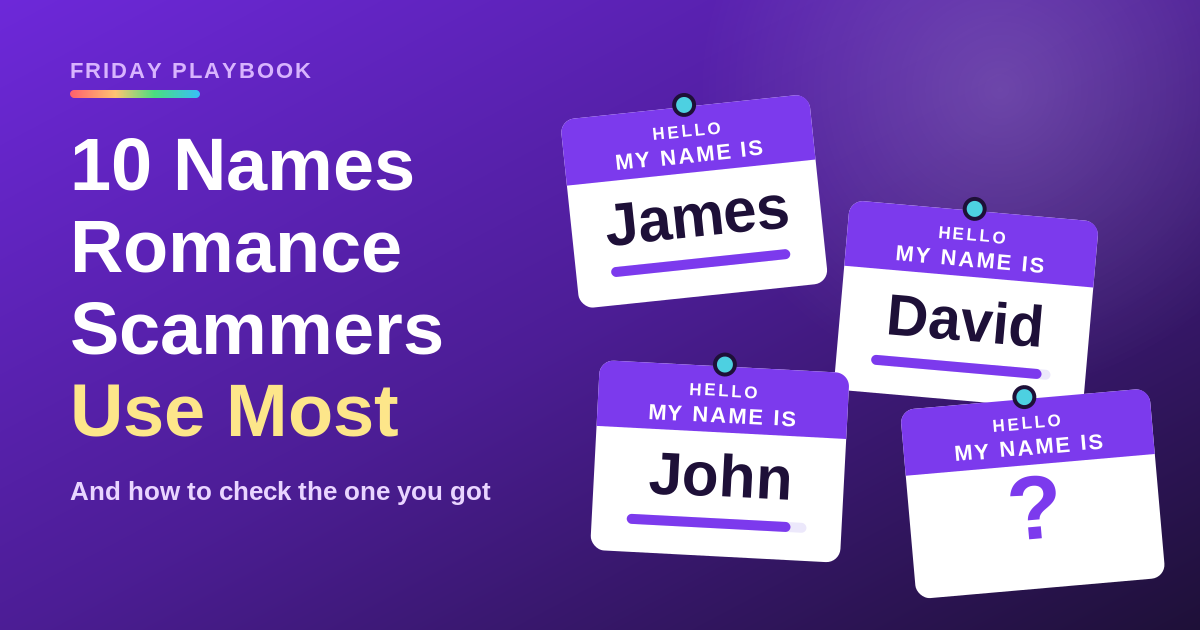
The romance scammer names that show up most in victim reports are ordinary, trustworthy-sounding Western names: James, David, John, Mark and Michael lead one long-running database. That is the point. A common name does not raise suspicion and raising suspicion is the last thing a scammer wants to do. Below are the 10 male names that appear most in documented victim reports, what the pattern actually tells you, and how to check the name you were given.
Name Search Examples
To get more accurate results, enter the full name including at least First name, Middle name and Last name.
Email Search Examples
Phone Search Examples
Username Search Examples
Address Search Examples
Start typing the initial part of the address and select from the addresses given dropdown afterward.
We Respect Your Privacy.
The 10 Male Names Reported Most
Social Catfish · Name Wall
Hello, my name is… ordinary.
These are the first names reported most in one victim-run database of romance scam cases. Tap a tag. The takeaway: a name is just a label, so check the photo and the story behind it.
Source: ScamWarners victim-report database, 27,624 cases from 2007 to 2026. It reflects reports submitted to that site, not every scam. A name alone doesn’t show someone is a scammer, and a search can’t confirm who is behind a profile. Private and confidential — only you see the results.
1-8: The Classic Western Names
James, David, John, Mark, Michael, Robert, Frank, and Richard are all common, plain, trustworthy-sounding names. Scammers choose names that fit the identity they are building: an American engineer, a widowed businessman, a deployed soldier, an oil rig worker. The name is chosen to match the story, not to stand out.
This is why the name matters far less than the combination of name, job, and behavior. A “John” who says he is an offshore engineer, cannot video call, and needs emergency funds to get home is not suspicious because his name is John; he is suspicious because of the pattern. For the jobs that go with these names, see our guide on the jobs romance scammers pretend to have.
9: Kelvin
Kelvin appears in the ScamWarners database at a rate that is disproportionate to how common the name is in the Western countries scammers typically claim to be from. The name is more widely used in West Africa than in the United States, United Kingdom, or Australia. A name that does not match the claimed nationality or background is one of the mismatches worth noting, not because it proves anything, but because it is inconsistent with the story.
10: Alex
A short, neutral name that works for almost any profile and is easy to remember across a long conversation. Alex also shows up frequently as a nickname; some scammers introduce a longer name early and then shift to a shorter version as the conversation becomes more familiar, which is a normal social pattern that makes the transition feel natural.
What About Female Scammer Names?
The same ScamWarners database shows Mary (128 reports), Rose (101), and Anna (101) among the most reported female first names. Scammers posing as women use the same approach: a warm, familiar name attached to someone else’s photos. A woman’s name on a profile carries no more or less suspicion than a man’s, and men are targeted by romance scams as frequently as women in many documented categories.
Name Search Examples
To get more accurate results, enter the full name including at least First name, Middle name and Last name.
Email Search Examples
Phone Search Examples
Username Search Examples
Address Search Examples
Start typing the initial part of the address and select from the addresses given dropdown afterward.
We Respect Your Privacy.
What a Name Does and Does Not Tell You
A common name proves nothing.
James and David appear in thousands of reports because millions of real people have those names. Finding the name on a list like this one does not make the person a scammer.
The name may be borrowed from a real person.
Scammers frequently copy real people’s names, photos, and sometimes even military ranks and unit details. A name that checks out as real because it belongs to a real person may still be attached to someone using that person’s identity without their knowledge. A U.S. Army officer has reported hundreds of fake accounts using his name and photos, according to media coverage of the ongoing problem. A name that exists is not the same as a genuine profile.
Mismatches are worth noting.
A name that does not fit the claimed country, age, or background; a name that is common in West Africa on a profile claiming to be from California; or a last name used as a first name points toward a manufactured profile. The mismatch alone is not confirmation of anything, but it is a reason to look more carefully.
Patterns beat names.
The behaviors that define romance scams are more reliable signals than any name on a list: never meeting in person, avoiding video calls, moving the conversation off the original app, and eventually asking for money. For the specific phrases that accompany these patterns, see our guide on romance scammer phrases.
How to Check the Name You Got
Search the photo first.
A reverse image search is more useful than a name search because scammers reuse photos across profiles and platforms. If the same face appears under different names or on different platforms, that is a direct signal. Upload any photo they have shared to Social Catfish’s reverse image search; the facial recognition finds where that face appears online and under what names. See our guide on the most common romance scam photos for what borrowed photos typically look like.
Search the name with the story.
Search their full name alongside the job or location they claim. Look for matching profiles, news mentions, or reports from other people describing the same name, job, and story. A “David Miller” claiming to be a petroleum engineer in Aberdeen who can never video chat is a searchable combination of details.
Search the name, username, email, or phone number.
Enter any identifier they have shared into Social Catfish’s cross-platform search. The search returns every platform where that identity is active alongside the real identity connected to it. A name that surfaces consistently under the same identity across multiple platforms presents a different picture than a name that exists only in the conversation you are having.
Ask for a live video call and watch for the excuses.
A specific, unscripted request on a live video call hold up a piece of paper with a word you name, or wave a hand directly in front of the camera is harder to fake than a name. Repeated technical excuses for why this cannot happen are a more reliable signal than any name on any list.
Never send money, gift cards, or cryptocurrency to someone you have not independently verified.
A Social Catfish search can show where a name, photo, username, email, or phone number appears online. It cannot tell you whether someone is a scammer or confirm who is behind a profile. What it can do is surface inconsistencies between what someone has told you and what is actually findable about that identity online.
Name Search Examples
To get more accurate results, enter the full name including at least First name, Middle name and Last name.
Email Search Examples
Phone Search Examples
Username Search Examples
Address Search Examples
Start typing the initial part of the address and select from the addresses given dropdown afterward.
We Respect Your Privacy.
FAQ
In ScamWarners’ database of victim reports, the most reported male first names are James, David, John, Mark, and Michael, followed by Robert, Frank, Richard, Kelvin, and Alex. Mary, Rose, and Anna are among the most reported female names. These are common names shared by millions of real people; their appearance on a list is not a reason to distrust anyone who has one of them.
No. Common names are shared by millions of real people, and scammers also copy real identities, including real names. Behavior and independent verification matter far more than the name someone gives you.
Sometimes. Scammers can copy the name, photos, and biographical details of a real person, including military members, and have been found to have created hundreds of fake accounts using their identity. A name that exists and checks out as real is not proof the profile is genuine, because the name may belong to someone else entirely.
Stop sending money or personal information, save all messages and screenshots, report the profile on the platform and the scam to the FTC and FBI, and contact your bank immediately if money has already been transferred.